Step 01
Origination and pipeline
Organize commercial discussions, proposals and business cases in a workflow that keeps sales and marketing moving with structure.
Portfolios are growing. Systems and teams aren't keeping up.
Asset & Lease Planning System, "ALPS" in short, gives lessors and asset managers one integrated platform for pipeline, agreements, asset operations, invoicing, and portfolio reporting so teams can scale with full visibility and sharper control. For portfolios from one asset and more.
Whether you are building a new platform, professionalising an existing operation, or replacing fragmented internal processes, ALPS gives your team a clearer path to disciplined execution and confident growth.
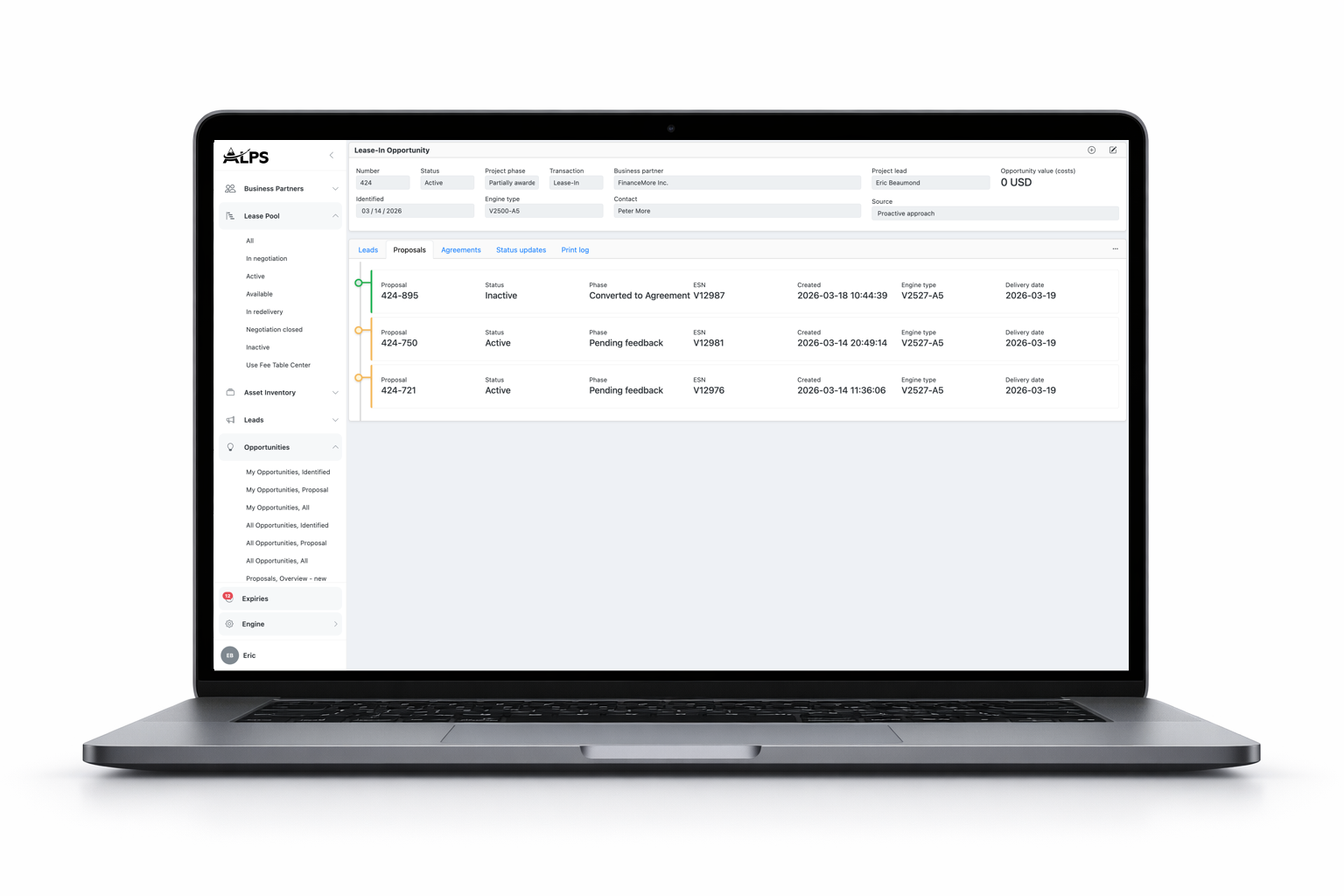
ALPS reflects how lessors actually operate. Commercial, contractual, operational, and financial activity are not treated as separate islands. They flow as one connected operating model.
Organize commercial discussions, proposals and business cases in a workflow that keeps sales and marketing moving with structure.
Convert commercial terms from a proposal to a contract, get approvals, and execute with strongest control over the handoff.
Maintain visibility over availability, milestone tracking, lease return processes and supporting dashboards.
Enable financial overview and portfolio-level reporting directly from the underlying activity. Live.
Instead of stitching together a CRM, a contract tool, a finance system, utilization sheets and an asset tracking spreadsheet, ALPS gives teams one operating environment for every stage of portfolio management.
Track opportunities, counterparties, and proposal activity in a workflow that keeps commercial momentum visible, controlled, and linked to downstream execution.
Move from proposal to contract execution without losing continuity between negotiation, documentation, and the operational reality that follows.
Maintain visibility across asset types, portfolios, expiries, obligations, documents, and lifecycle events. All in one shared system rather than a patchwork of trackers.
Invoice from agreed terms supplemented with utilization as reported in the integrated ALPS Utilization Portal. Fully automatic.
Give leadership a live view of activity, exposure, and performance without depending on manual reconciliation or exports from disparate systems.
No feature gates. No modules. Adopt the full product, establish the right operating model from the first moment and grow without artificial barriers or paywalls.
A platform handling portfolio-critical information needs explicit trust. ALPS is designed with the controls, governance, and technical posture that serious enterprise buyers expect to see before any contract conversation begins.
Each customer runs on a dedicated server environment, removing any possibility of data spillover between organisations. Operational separation by design, not by policy.
Every action can be governed by user role: who can see, change, approve, or execute each step. Information visibility reflects the real structure of your business.
All data is encrypted in transit and at rest as a baseline. Your data is not accessible for us to view or edit as part of normal operations, and never used beyond supporting your environment.
ALPS is free to run sales, invoice and operate internally. You can structure assets, customers, agreements, workflows, get proposal and contract expiry alerts and have full reporting without any platform charges. Pricing begins only when ALPS is supporting with active agreements.
Build your operating foundation on one complete product rather than layering capabilities over time.
Keep teams on a single system designed to bring clarity, continuity, and control to the full portfolio lifecycle.
Grow the asset pool without limit: larger portfolios run from the same core operating system.
Commercial charges begin only when ALPS is supporting active agreements, aligning cost with execution.
ALPS is built by a team with more than a decade of operational experience in aviation portfolio management (across transactions, asset management, and process improvement), supported by practical digitalisation expertise.
That background led to a clear conclusion: growing portfolios lack an integrated solution that gives them a strong operational backbone without forcing them into fragmented systems or heavyweight legacy tools. ALPS was created to change that.
The platform is not a collection of disconnected features. It is the operating foundation of the portfolio: one place to manage the workflows, decisions, and records that matter most.
ALPS gives portfolio teams the structure to grow deliberately, the visibility to make decisions faster, and the operating discipline to scale with confidence from the first asset onwards.